
Proximion is the leading supplier of advanced Fiber Bragg Gratings (FBGs) based products with a capability to manufacture straight, chirped or tilted FBGs with a customized group delay profile. Proximion uses a unique and flexible writing technique, which allows for smaller series but also enables scaling to high volume production due to a highly automated production process.
Fiber Bragg Gratings
Our Fiber Bragg Gratings
How our FBG technology works
Our ultra-long FBGs are inscribed with our versatile and proprietary grating writing technique that gives us unparalleled possibilities.
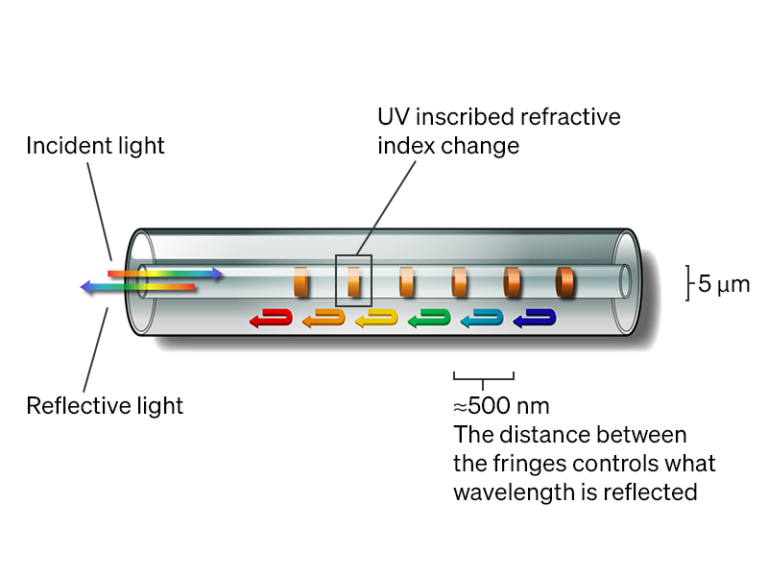
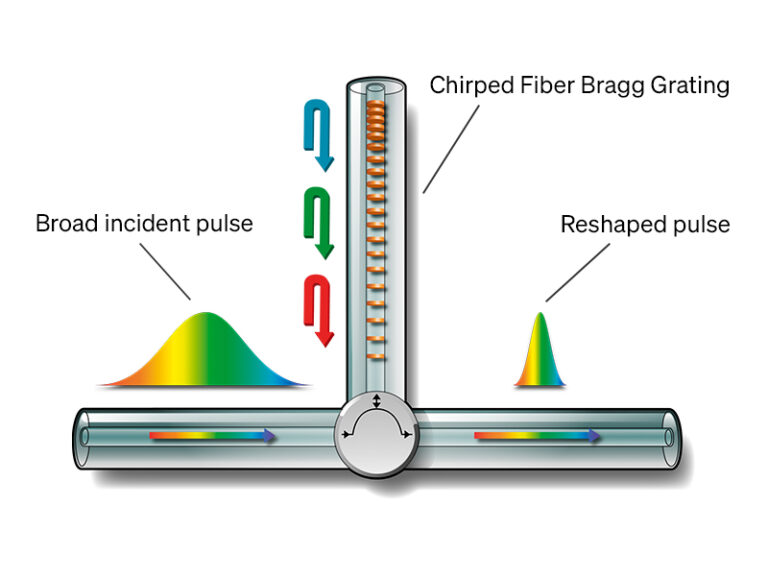
The Chirped FBG – a key component for telecoms and optical measurement
A chirped FBG is a special type of FBG in which the period of the grating varies linearly along its length. The result is a wavelength selective filter where a broad range of wavelengths are reflected from different locations along the CFBG.
In this way, the CFBG can be designed to modify the characteristics of a spectrum, such as narrowing or broadening the optical pulse. Click the link below to see the multiple applications of this remarkable optical element.